

What Makes Wild Garlic Worth Knowing
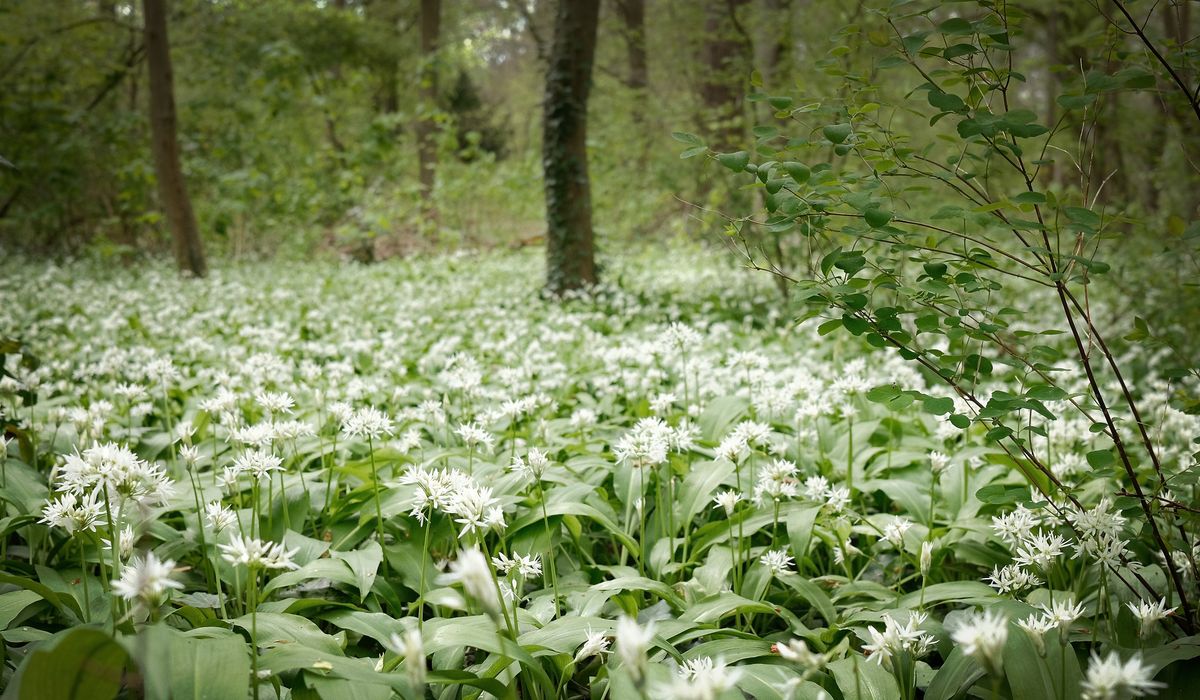
Few things in a British spring are quite as cheering as a woodland floor carpeted with wild garlic. Also known as ramsons, and to botanists as Allium ursinum, it arrives in March and is usually gone by early June, which is part of its charm. For a few weeks you can walk into a wood and smell it before you see it: a warm, green, unmistakable garlic scent that seems to hang in the damp air.
It is one of the most beginner-friendly wild foods we have, because it is abundant in the right places, easy to use, and — crucially — has a whole sensory test built into it. But it also grows alongside one genuinely dangerous lookalike, so the identification needs to be done properly rather than casually. This guide is about doing it properly.
Where and When to Find Wild Garlic in the UK
Wild garlic likes damp, shaded, slightly acid ground. Think ancient deciduous woodland with bluebells nearby, stream banks, ditch sides, hedge bottoms, and the shaded edges of old lanes. It often grows in huge colonies, which is exactly why it is such a good beginner's plant: once you have found one patch, you will find it there every year at the same time.
- Season: leaves from late February or March, flowers from April to June.
- Habitat: shade, moisture, and soil that never quite dries out.
- Companions: bluebells, wood anemone, dog's mercury and ferns are all good signs you are in the right sort of wood.
- Avoid: roadside verges, sprayed field edges, and anywhere heavily used by dogs.
The Leaves: Getting the Identification Right
A single wild garlic leaf is long and lance-shaped, tapering to a soft point, usually somewhere between 15cm and 25cm when fully out. The colour is a rich, slightly glossy green, and the surface is smooth and hairless — no fuzz, no leathery feel. It is soft enough that it flops a little in the hand.
Two details matter more than the shape. The first is that each leaf grows on its own slender stalk rising straight from the base of the plant, so a clump looks like a bundle of separate stems rather than a rosette of leaves radiating from one point. The second is the stalk itself: run a thumbnail along its underside and you will feel a distinct ridge or keel, so it is slightly V-shaped in cross-section rather than round. Once you have noticed this, you will not un-notice it.
Later in the season, white star-shaped flowers appear in loose clusters on a single slender stem above the leaves. Six petals, held openly, nothing like a bell or a trumpet. The unopened buds are excellent eating too, and the flowers make a lovely scattered garnish.
The Sniff Test — and Why It Isn't Quite Enough
Pick a leaf, tear it across, and sniff. Wild garlic should hit you immediately with clean, sharp garlic — not faint, not grassy, not vaguely oniony. If there is no garlic smell, put it down and walk away.
That said, do not rely on scent alone. Build a picture using several checks together:
- Scent: strong garlic on a torn leaf.
- Stalk: one stalk per leaf, keeled underneath.
- Arrangement: separate stems from the base, not paired leaves from a shared sheath.
- Underside: uniformly green and soft, with no blotches or speckling.
If any one of these feels wrong, leave the plant alone. There is no prize for guessing, and there is always another patch.
The Dangerous Lookalikes You Must Learn
Lily of the valley (Convallaria majalis) is the one that matters most. It is seriously toxic, containing cardiac glycosides, and it grows in similar woodland and garden-edge settings, sometimes within a few metres of wild garlic. Its leaves are also broad, green and spring-fresh, but the differences are consistent once you know them. Lily of the valley produces two or three leaves that emerge from the same point and wrap around a shared stem, forming a sheath at the base. The leaves are stiffer and more rubbery than wild garlic, with a slightly bluish-green cast, and the flowers are white bells hanging in a row down one side of the stem. Crucially, there is no garlic smell at all.
Autumn crocus (Colchicum autumnale) sends up broad, glossy leaves in spring, before flowering in autumn. It is highly toxic and grows in open grassland and meadows rather than deep shade. Lords-and-ladies (Arum maculatum) has arrow-shaped leaves, often with dark blotches, and appears on hedge banks in early spring. Neither smells of garlic.
Picking Well, Eating Well
Pick leaves above ground with scissors rather than pulling, so the bulb stays put and the patch returns next year. In the UK you may gather leaves and flowers by hand for personal use on land where you have lawful access, but uprooting a plant — bulb and all — requires the landowner's permission, and picking is banned on many nature reserves and Sites of Special Scientific Interest. Take a modest handful from each large clump and move on.
Wash your haul well, then use it raw wherever you can: whizzed into pesto, folded through butter, shredded into salads, or stirred into soup at the very end of cooking. Heat flattens that bright garlic flavour, so treat it as a herb rather than a vegetable. Anything you cannot use within a couple of days will freeze happily as pesto or chopped in butter. And if you are ever standing over a leaf wondering whether you are certain — that is your answer. Leave it, and enjoy the walk instead.


Coding is used in almost all aspects of life and work now, be it directly or indirectly. It’s not just for companies in the tech sector. “An increasing number of businesses rely on computer code,
Coding is used in almost all aspects of life and work now, be it directly or indirectly. It’s not just for companies in the tech sector. “An increasing number of businesses rely on computer code,
Coding is used in almost all aspects of life and work now, be it directly or indirectly. It’s not just for companies in the tech sector. “An increasing number of businesses rely on computer code,